
A real estate elective CE course is a state-approved educational program that counts toward the elective portion of a licensed agent’s or broker’s continuing education requirements for license renewal. Unlike mandatory core courses, electives give you the freedom to choose subject matter that fits your market focus, career goals, or areas where you want deeper expertise. Most states require a mix of core and elective hours every two to three years, and understanding how electives work can mean the difference between a smooth renewal and a last-minute scramble. Colorado requires 24 hours over a three-year period, with 12 of those hours designated as electives, which shows just how significant the elective portion is in most renewal cycles. Formats range from self-paced online modules to live webinars and in-person classes, making it easier than ever to fit CE into a packed schedule.
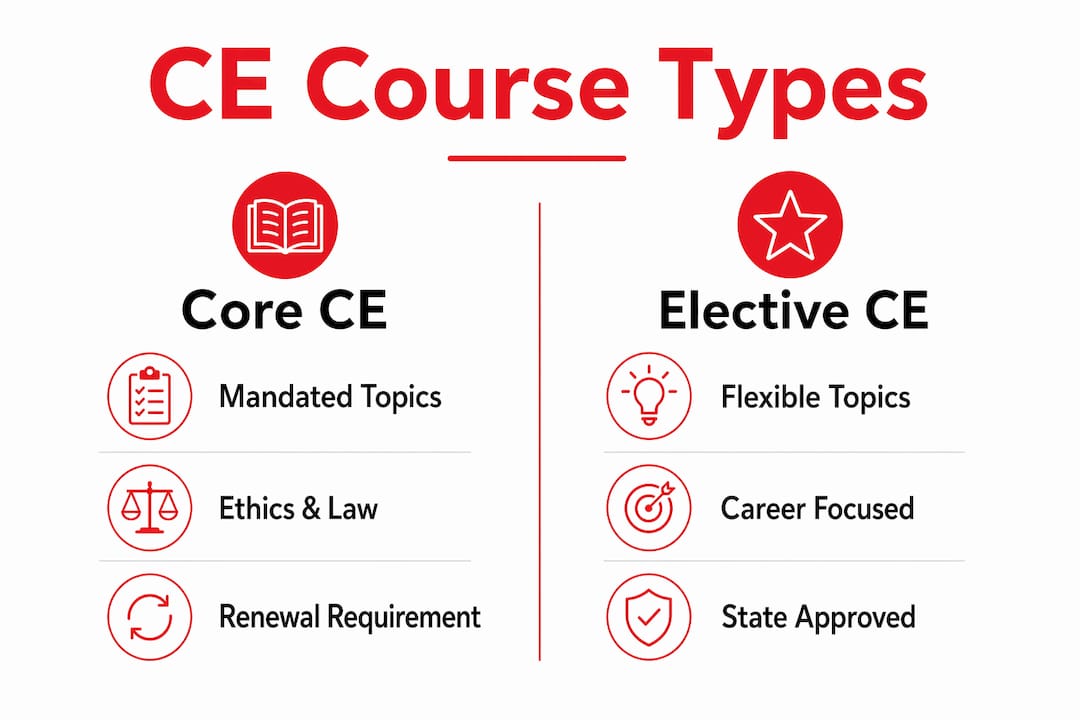
The clearest way to understand elective CE is to compare it directly with core continuing education. Core courses cover mandatory topics set by your state’s real estate commission. These typically include legal updates, ethics, fair housing law, and agency relationships. You have no choice in the matter. Every licensed broker in that state takes the same core content during the renewal cycle.
Elective courses work differently. They fill the remaining required credit hours with topics you select from a state-approved catalog. The subject matter is broader, more specialized, and often more directly tied to what you actually do day to day. A commercial broker might choose a course on lease negotiation. A residential agent focused on investment properties might pick a course on tax deferral strategies.

Here is how the two categories compare across the most common criteria:
| Category | Core CE courses | Elective CE courses |
|---|---|---|
| Content | Mandated topics (ethics, legal updates, fair housing) | Agent-chosen topics from approved catalog |
| Flexibility | None. Topics are fixed by the state | High. You select from available options |
| Purpose | Regulatory compliance and consumer protection | Skill development and specialization |
| Credit hours | Typically 6 hours per cycle (varies by state) | Typically 6 hours per cycle (varies by state) |
| Provider requirement | Must be state-approved | Must be state-approved |
Illinois is a useful reference point. The Illinois IDFPR 2026 renewal requires 12 total CE hours split evenly: 6 core and 6 elective. That 50/50 split is common across many states, which means electives represent half of everything you complete for renewal. Treating them as an afterthought wastes a real opportunity.
The range of subjects available through elective CE courses is wider than most agents realize. Topics span finance, technology, taxation, contracts, property management, and more. The variety reflects the fact that real estate professionals work in dozens of different niches, and a one-size-fits-all curriculum would not serve them well.
Common elective CE topics include:
A strong example of what elective depth looks like in practice: the Greater Greenville Association of REALTORS offers a two-hour elective titled “Real Estate, Taxes & Deferral Strategies.” It covers tax fundamentals, capital gains exposure, 1031 exchanges, and DSTs. These are concepts that directly affect how you advise clients on investment decisions, yet they appear nowhere in standard core curricula. That is exactly the kind of specialized knowledge that separates a generalist agent from a trusted advisor.
Topics vary by state and provider, so the real estate CE credit topics list available to you depends on where you are licensed. Checking your state commission’s approved course catalog is the only way to see what is currently on offer.
Pro Tip: Pick electives that align with the next phase of your career, not just the easiest credits to complete. If you plan to move into property management or commercial sales within two years, use your elective hours now to build that foundation.
Not every course you find online qualifies as approved elective CE credit. State real estate commissions maintain lists of approved providers and courses, and completing a course from a non-approved source will not count toward your renewal. This is one of the most common and costly mistakes licensees make.
Self-paced online courses are the most popular format for elective CE because they let you work through material on your own schedule. Live webinars, in-person classroom sessions, and hybrid formats are also widely available. Each format has the same approval requirement: the provider must be authorized by your state commission.
Here is how to verify and select an approved elective course:
Illinois adds one more nuance worth knowing. Sexual Harassment Prevention Training may count as elective hours in Illinois if completed through an approved provider. This is not automatic. The provider’s approval status determines whether the training applies to your elective total or simply satisfies a separate compliance obligation. Confirming this detail before you enroll can save you from needing an extra course at renewal time.
Selecting elective CE courses without a plan leads to wasted hours and sometimes missed renewal deadlines. A structured approach takes less than 30 minutes and protects you from compliance gaps.
Start by confirming your state’s total CE requirement and the core-versus-elective split. This information lives on your state commission’s website and changes periodically, so check it at the start of each renewal cycle rather than relying on what you did last time. Colorado’s 24-hour requirement with 12 elective hours is different from Illinois’ 12-hour requirement with 6 elective hours. Assuming they are the same is a mistake that real agents make every renewal period.
Next, check the approval status of any provider you are considering. The Illinois IDFPR requirement that courses come from approved providers is not unique to Illinois. Every state ties credit validity to provider authorization. A course from an unapproved source gives you knowledge but zero credit toward renewal.
Record keeping matters more than most agents acknowledge. Keep every certificate of completion in a dedicated folder, either digital or physical. Cross-reference your completed hours against your state’s license lookup tool at least once before your renewal deadline. Discrepancies between what a provider reported and what your record shows do happen, and catching them early gives you time to resolve them without penalty.
For Illinois licensees specifically, confirm whether your Sexual Harassment Prevention Training provider is state-approved for elective credit. This training may count toward your 6 elective hours if the conditions are met, which effectively lets you satisfy a compliance requirement and a CE requirement simultaneously.
Pro Tip: Map out your elective hours at the beginning of your renewal cycle, not the end. Spreading two or three courses across 18 months is far less stressful than completing six hours in the final two weeks before your license expires.
You can explore continuing education requirements by state through Recareercenter to get a clear picture of what your specific renewal demands before you enroll in anything.
Elective CE courses are the half of your renewal requirement that you actually control, and using them strategically builds expertise that core courses never will.
| Point | Details |
|---|---|
| Definition of elective CE | State-approved courses that fill the non-mandatory portion of your CE renewal requirement. |
| Core vs. elective split | Most states divide CE hours evenly; Illinois requires 6 core and 6 elective hours per cycle. |
| Topic range | Electives cover taxes, technology, contracts, commercial real estate, and more beyond core mandates. |
| Approval is non-negotiable | Credits only count when the provider is authorized by your state real estate commission. |
| Strategic selection | Aligning electives with your career goals turns a compliance task into a professional development asset. |
I have worked with real estate professionals at every stage of their careers, and the pattern I see most often is this: agents treat elective CE as a box to check rather than a resource to use. They pick whatever is cheapest or fastest, complete it the week before their license expires, and move on. That approach technically keeps the license active. It does nothing for the career.
The agents who grow their income and their reputation over time are the ones who use elective hours to go deep on something. A residential agent who takes three consecutive cycles of electives on investment property analysis starts to speak a language that most residential agents cannot. Clients notice. Referrals follow.
There is also a regulatory literacy argument here. The real estate industry changes faster than most people outside it realize. Tax law shifts, technology rewrites how transactions happen, and state regulations evolve. Elective courses tied to current market conditions keep you ahead of those changes rather than catching up to them. A course on AI tools for agents or 1031 exchange strategies is not just interesting. It is a direct investment in your ability to serve clients better than the agent down the street.
The other thing I would push back on is the idea that elective courses are somehow less rigorous than core courses. A two-hour course on DSTs and tax deferral strategies from the Greater Greenville Association of REALTORS requires you to understand capital gains exposure, exchange mechanics, and trust structures. That is not light material. Approach electives with the same seriousness you bring to core content, and you will get far more out of them.
— Noelle

Recareercenter offers state-approved real estate continuing education across New Jersey, New York, Florida, and Pennsylvania, with formats that fit around your schedule. Whether you prefer self-paced online learning or live instruction, the course catalog includes elective options covering property management, commercial real estate, investing, and technology for agents. You can browse the full real estate CE catalog to find elective courses that match your renewal requirements and your professional goals. For agents renewing in New Jersey specifically, the NJ CE renewal course covers 12 credits online and includes elective-eligible content. All courses meet state approval standards so your hours count when it matters most.
A real estate elective CE course is a state-approved educational program that satisfies the elective portion of a licensed agent’s or broker’s continuing education renewal requirement. It differs from core CE in that you choose the subject matter from an approved catalog rather than completing a fixed mandatory curriculum.
Requirements vary by state, but most divide total CE hours between core and elective categories. Illinois requires 6 elective hours out of a 12-hour total, while Colorado requires 12 elective hours out of a 24-hour total over three years.
Yes. Credits only count toward license renewal when the course comes from a provider authorized by your state real estate commission. Completing a course from a non-approved source gives you no renewal credit, regardless of the subject matter or hours spent.
Common elective topics include tax deferral strategies like 1031 exchanges, advanced contract writing, real estate technology, property management, commercial leasing, and appraisal methods. Available topics depend on your state’s approved course list and the providers operating in your market.
In Illinois, Sexual Harassment Prevention Training may count toward elective hours if completed through a state-approved provider. This is not automatic, so confirm the provider’s approval status before enrolling if you intend to apply it to your elective total.