
Real estate license requirements by state are governed individually, meaning every state sets its own rules for pre-licensing education hours, exam structure, application fees, and reciprocity agreements. Florida requires 63 hours of pre-licensing education, Texas demands 180 hours, and California sits at 135 hours. These gaps are not arbitrary. They reflect each state’s property law complexity, consumer protection standards, and regulatory philosophy. If you plan to get licensed or transfer an existing license, knowing your state’s exact sequence before you spend a dollar is the most practical thing you can do.
Every state real estate licensing program follows the same general framework: complete pre-licensing education, pass a state exam, submit an application, and maintain the license through continuing education. The variation lives inside each of those steps. Real estate licensing is regulated at the state level, so matching your state’s exact sequence of education, exam, application, and renewal steps is not optional. Skipping or reordering steps can invalidate your application entirely.
The licensing process typically involves four components: pre-licensing coursework, a two-part state exam, a formal application with supporting documents, and periodic renewal with continuing education. Some states add fingerprinting, background checks, or experience verification for broker candidates. Understanding this structure upfront saves you from costly surprises mid-process.

Pre-licensing education requirements vary greatly by state, ranging from 40 to 180 or more hours. Florida requires 63 hours, Texas requires 180 hours, and California requires 135 hours. That range means a Texas candidate spends nearly three times as many hours in coursework as someone in a lower-hour state. The hour count directly affects how long it takes you to sit for your exam.
The content of those courses covers real estate principles, contracts, property law, finance, and state-specific regulations. Higher-hour states tend to include more elective or specialty topics, such as property management or commercial transactions. Lower-hour states concentrate on core principles and state law, expecting you to build depth through experience after licensing.
Pro Tip: Check your state’s approved provider list before enrolling in any pre-licensing course. Completing hours through an unapproved school means starting over, regardless of how many hours you logged.
You can review a detailed state-by-state licensing timeline to understand how education hours translate into realistic calendar timelines before your exam date.
Most states require passing a two-part exam covering national real estate principles and state-specific laws. The national section tests concepts like agency relationships, contracts, financing, and fair housing. The state section tests local property law, license law, and state-specific regulations. Passing both sections is required to receive a license, and many states require you to pass both on the same attempt.
The two dominant third-party testing providers are PSI and Pearson VUE. Most states contract with one of these providers for scheduling, administration, and scoring. You register directly through the provider’s website, pay an exam fee, and select a testing center or remote proctoring option. Exam fees typically run between $40 and $100 per attempt, and retakes require a new fee payment.
Timing rules matter as much as passing scores. Utah requires candidates to pass the sales agent exam within one year of completing pre-license coursework and submit their application within 90 days of passing. Missing that 90-day window means the exam result expires and you must retest. This kind of deadline is easy to overlook when you are focused on studying, but it can cost you both time and money.
Pro Tip: Schedule your exam date before you finish your coursework, not after. Most testing providers allow advance booking, and having a fixed exam date creates accountability that improves pass rates.
The national average licensing cost approximates $307, covering education, exam fees, and background checks. First-year business expenses can add $500 or more on top of that. That $307 figure is an average, not a ceiling. Some states push total costs well above $500 when you factor in all required components.
Fee categories go beyond the basic application fee. Here is what you should budget for:
Utah’s broker application totals $160 for the application itself, which includes the recovery fund component. That figure does not include fingerprinting, exam fees, or coursework. Broker candidates in Utah also face additional documentation requirements, including notarized experience forms and verification letters from supervising brokers.
Pro Tip: Budget for at least one exam retake when you plan your licensing costs. Most candidates do not pass both sections on the first attempt, and the retake fee is non-refundable.
Reciprocity is the formal agreement between states that allows a licensed agent from one state to obtain a license in another state with reduced requirements. Twenty-nine states offer some form of reciprocity, but most still require state-specific education or exam components. Reciprocity reduces your workload. It does not eliminate it.
The most common misconception is that reciprocity means automatic licensure. It does not. Here is what reciprocity typically does and does not cover:
Hawaii uses an equivalency approach. Hawaii allows out-of-state licensees to sit for only the state-specific exam portion if they have already passed the uniform national section in another state. This partial exam waiver is a practical benefit, but candidates still complete Hawaii’s application process, pay applicable fees, and meet any additional state requirements.
States with limited or no reciprocity include California, Florida, and Michigan. If you hold a New York license and want to practice in California, you start the California process from scratch. Verifying your destination state’s exact rules before relocating is not optional. You can find detailed guidance on getting licensed in another state to avoid costly assumptions about what transfers.
Continuing education (CE) requirements determine whether your license stays active between renewal cycles. Missing a CE deadline does not just delay renewal. It can push your license into inactive or suspended status, which stops you from practicing legally. Missing CE deadlines can lead to inactive or suspended licenses, and reinstating a suspended license often requires additional fees and paperwork.
North Carolina’s 2026 CE requirements illustrate how specific these rules get:
That last point catches many agents off guard. Paying your renewal fee on time does not protect your active status if CE is incomplete. North Carolina’s structure is not unique. Many states separate CE reporting from renewal billing, creating two independent deadlines you must track.
CE topics vary by state but commonly include ethics, fair housing, agency law, and state law updates. Some states require specific courses, such as a designated update course that changes content annually. Others allow agents to choose from an approved elective catalog. Recareercenter offers continuing education courses aligned with state-specific requirements, including options for agents in New Jersey, New York, Florida, and Pennsylvania.
Real estate license requirements by state follow a consistent framework of education, exam, application, and renewal, but the specific rules, costs, and timing windows inside that framework differ enough to derail unprepared candidates.
| Point | Details |
|---|---|
| Education hours vary widely | Florida requires 63 hours, Texas 180 hours; verify your state’s requirement before enrolling. |
| Timing windows are binding | Utah’s 90-day application window after exam pass is non-negotiable; missing it requires retesting. |
| Total costs exceed the application fee | Budget for fingerprinting, exam fees, recovery fund fees, and at least one retake attempt. |
| Reciprocity reduces but does not eliminate requirements | Most states still require the state-specific exam and a new application even with reciprocity. |
| CE and renewal are separate deadlines | Paying renewal fees does not protect active status if CE is incomplete by the state’s deadline. |
I have seen candidates spend months preparing for an exam, pass it, and then lose their eligibility because they missed a 90-day application window. That is not a knowledge failure. It is a planning failure. The licensing process rewards people who treat it like a project with dependencies, not a checklist they work through casually.
The agents who struggle most with state licensing are the ones who assume their home state’s rules apply everywhere. They research reciprocity once, read a summary that says “29 states offer reciprocity,” and stop there. What they miss is that reciprocity agreements are bilateral and specific. New Jersey and New York have a reciprocity arrangement. New Jersey and California do not. Reading the actual state board’s current rules, not a third-party summary, is the only reliable approach.
Fee budgeting is the other consistent blind spot. The $307 national average sounds manageable until you add exam prep materials, association dues, errors and omissions insurance, and MLS fees in your first year. The licensing fee is the entry ticket. The first-year operating costs are the real financial commitment. Agents who plan for $1,500 to $2,000 in total first-year costs are rarely surprised. Agents who plan for $307 often are.
My practical advice: map out your state’s exact sequence, identify every deadline and fee category, and build a calendar that works backward from your target license date. Start CE early in each renewal cycle, not in the final month. And if you are transferring a license, call the destination state’s licensing board directly. Their staff will tell you exactly what transfers and what does not, in plain language, for free.
— Noelle
Choosing the right pre-licensing program is the single decision that most affects how smoothly the rest of your licensing process goes. Recareercenter offers state-approved, ARELLO-certified real estate courses for New Jersey, New York, Florida, and Pennsylvania, with live online, in-person, and self-paced formats that fit around your existing schedule.
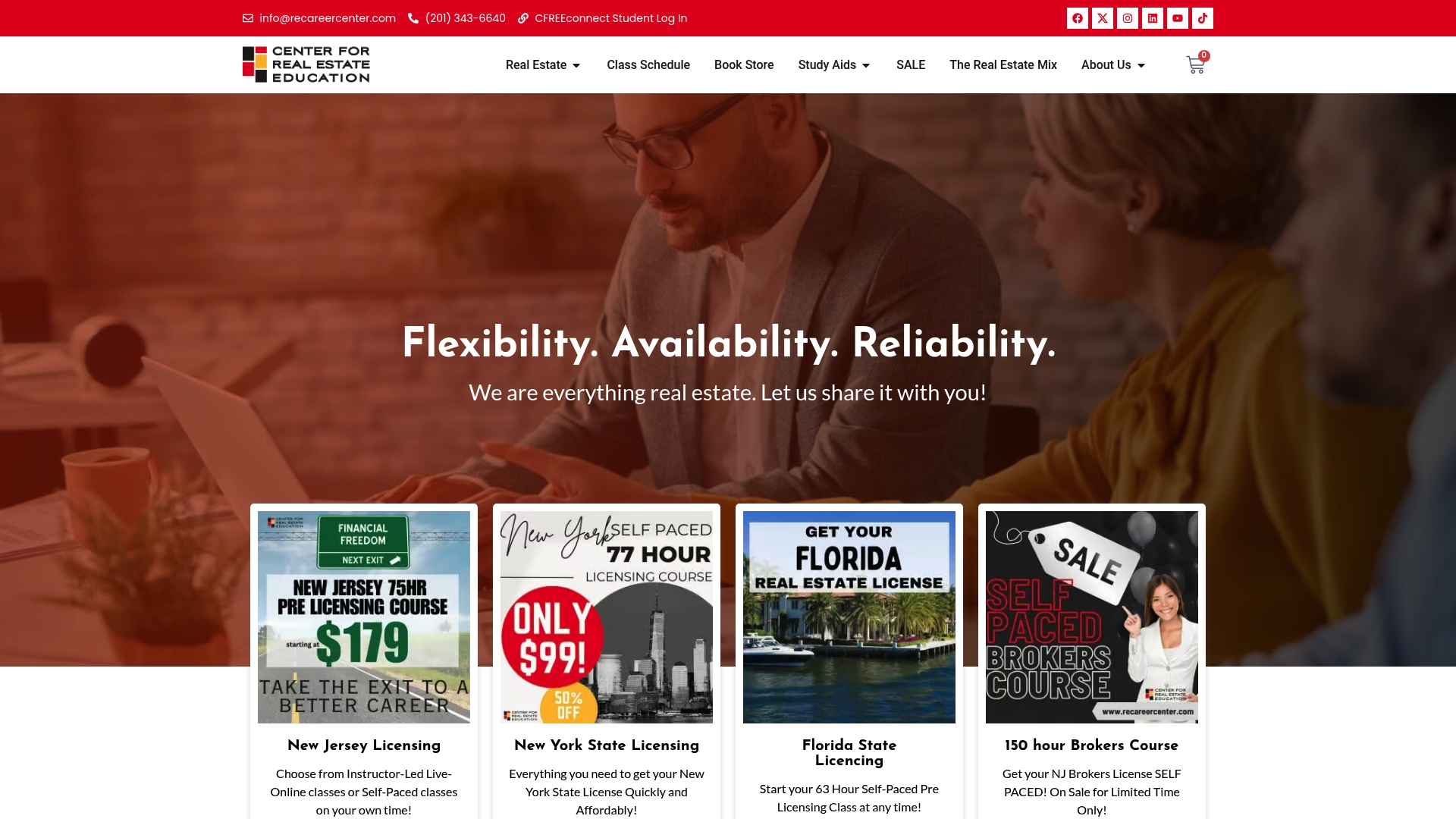
Whether you are starting from scratch, preparing for a state exam, or completing CE to maintain an active license, Recareercenter’s programs are built around real-world application, not just exam memorization. Explore the full catalog of real estate courses to find the program that matches your state’s requirements and your timeline. If you are weighing your delivery options, the comparison of online vs. in-person learning breaks down exactly what works for different schedules and learning styles.
Pre-licensing hours range from 40 to 180 or more depending on the state. Florida requires 63 hours, California requires 135 hours, and Texas requires 180 hours.
Not always. Reciprocity often reduces but does not eliminate requirements. Most states still require the state-specific law exam portion and a new application, even when the national exam section is waived.
The national average licensing cost is approximately $307, covering education, exam fees, and background checks. First-year business expenses can add $500 or more beyond that figure.
Missing CE deadlines can result in an inactive or suspended license. In North Carolina, for example, agents who do not complete 8 CE hours by June 10 lose active status regardless of whether they have paid their renewal fee.
This varies by state. Utah requires application submission within 90 days of passing the sales agent exam. Submitting after that window invalidates the exam result and requires retesting.