
The state portion of the real estate licensing exam is defined as the section that tests your knowledge of laws, regulations, and practices unique to the state where you seek licensure. Understanding why real estate exam has state portion requirements is not optional knowledge. Real estate law is state-specific rather than federal, which means a buyer’s agent in New Jersey operates under a completely different legal framework than one in Florida. Both the national and state sections must be passed independently, and failing one means retaking only that section. This structure exists to protect consumers and confirm that every licensed agent meets the minimum legal standards of their specific jurisdiction.
The state portion exists because each state enforces unique laws covering license law, administrative rules, agency disclosure requirements, and state-mandated contract provisions that differ significantly across jurisdictions. Federal law sets a baseline for real estate practice, but states layer their own statutes on top of it. Those layers vary so much that a passing score on the national portion alone cannot confirm you are ready to practice legally in any specific state.
The split exam structure reflects a deliberate policy choice. State real estate commissions hold the authority to license agents within their borders, and they require proof that candidates understand local rules before granting that license. Without a dedicated state section, an agent could pass on general principles while remaining completely unaware of, for example, New Jersey’s specific agency disclosure timing requirements or Florida’s escrow handling rules.

This is also why reciprocity almost always requires passing the state-specific law portion even when the national portion is waived. When you move from one state to another, your general real estate knowledge transfers. Your knowledge of the new state’s statutes does not. The state portion is the jurisdictional checkpoint that confirms you have done that work.
The national and state portions of the real estate licensing exam test fundamentally different bodies of knowledge, and treating them as one continuous study task is a common mistake.
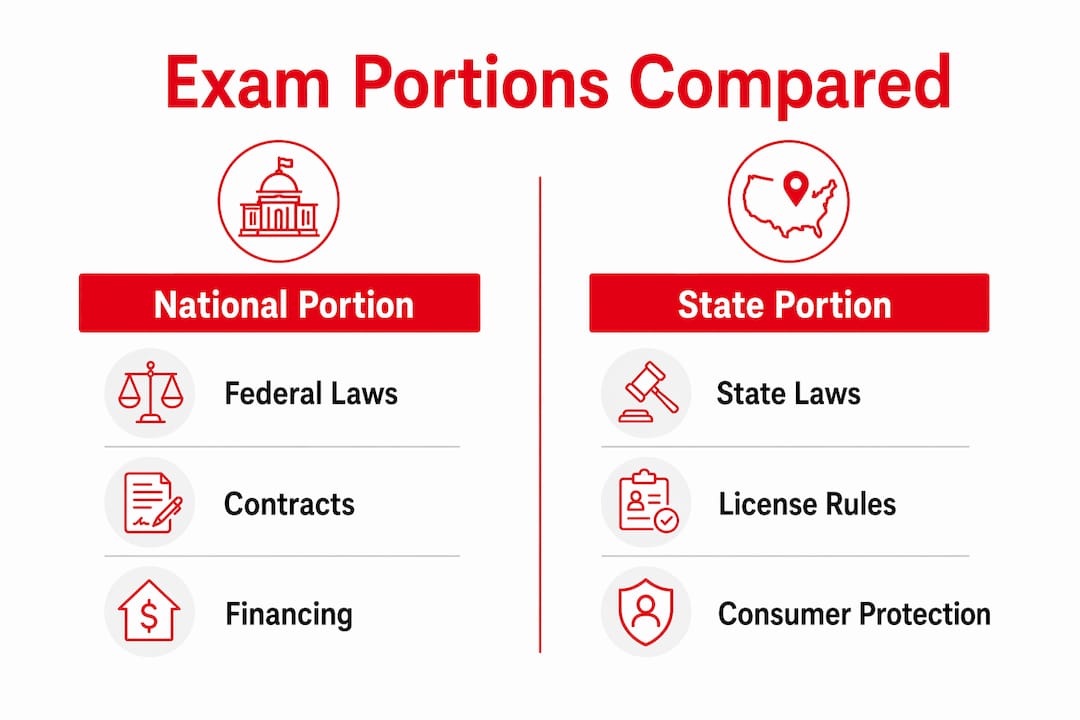
The national portion covers broad federal principles: property ownership, contracts, financing, appraisal concepts, and general agency law. It applies the same content framework regardless of where you plan to practice. The state portion covers state license law, disclosure requirements, commission rules, trust account regulations, and state-specific fair housing additions that go beyond federal law.
| Feature | National portion | State portion |
|---|---|---|
| Content focus | Federal principles and general concepts | State statutes, commission rules, local forms |
| Typical question count | 80–100 questions | 30–80 questions |
| Scoring | Independent pass required | Independent pass required |
| Retake rule | Retake only this section if failed | Retake only this section if failed |
| Study materials | National prep courses and textbooks | State content outline and state-specific practice tests |
In some states, scoring is fully independent. Candidates who fail only the state portion retake that section alone, which most states allow within a one-year window. That sounds like good news, but the math works against you on a shorter test. Missing five questions on a 40-question state section hurts your score far more than missing five on a 100-question national section.
Key differences to keep in mind:
The state portion is the primary mechanism states use to protect consumers from agents who lack knowledge of local law. State real estate commissions enforce compliance with local laws and regulations to prevent unethical practice and ensure agent accountability. That enforcement starts at the exam.
“The state section protects consumers by enforcing compliance with local laws and regulations to prevent unethical practice and ensure agent accountability. Agents must understand fiduciary duties, escrow handling, fair housing additions beyond federal law, and disciplinary procedures specific to their state before they are permitted to represent a single client.”
Consumers trust licensed agents to handle some of the largest financial transactions of their lives. A buyer who relies on an agent who does not understand state-mandated disclosure requirements can suffer real financial harm. The state exam portion ensures that harm is less likely by confirming minimum legal competency before a license is issued.
The state section specifically tests:
Real estate agents also carry accountability for consumer safety in the field, and state licensing laws address conduct standards that protect both clients and agents. The state exam portion is where that accountability begins.
The state licensing exam section covers a defined set of subject areas that vary by state but follow a recognizable pattern. Typical state portion topics include license law, administrative rules, agency disclosures, state contracts, escrow and trust account rules, state-specific fair housing laws, and disciplinary procedures.
Here is how those topics typically break down:
| Topic area | Why it appears on the state exam |
|---|---|
| License law and admin rules | Governs who can legally practice in the state |
| Agency disclosures | Protects consumers from undisclosed conflicts of interest |
| Trust account rules | Prevents mishandling of client funds |
| State contract forms | Ensures legally compliant transaction documents |
| State fair housing additions | Extends consumer protections beyond federal minimums |
| CE and renewal rules | Confirms agents maintain ongoing competency |
Reviewing your state’s official exam content outline before you begin studying tells you exactly which topics carry the most weight in your jurisdiction.
Treat the state and national sections as two separate exams that happen to occur on the same day. That mindset shift changes how you allocate study time and which materials you prioritize.
Pro Tip: Download your state real estate commission’s official content outline before you buy any prep materials. That document tells you exactly which topics are tested and how many questions each area carries. Build your study plan around it, not around a generic national prep course.
Preparation strategies that work specifically for the state section:
The smaller question count on the state section creates a narrower margin for error. Missing a few questions on a shorter state section impacts your score more than the same number missed on the national section. Candidates who fail the state portion often did not underperform on knowledge. They underperformed on preparation specificity.
Candidates adding a second state license should also know that reciprocity typically waives the national portion but requires passing the new state’s section. That means even experienced agents must study state law from scratch when crossing state lines.
The state portion of the real estate exam exists because real estate law is state-specific, and passing it confirms minimum legal competency within a defined jurisdiction, not general real estate knowledge.
| Point | Details |
|---|---|
| State law drives the split | Real estate is governed by state statute, making localized testing legally necessary for licensure. |
| Independent scoring matters | In some states, failing the state section requires retaking only that part, but the shorter format amplifies each missed question. |
| Consumer protection is the core purpose | The state section confirms agents understand fiduciary duties, escrow rules, and local fair housing protections. |
| State-specific prep is non-negotiable | National prep materials alone are insufficient; use your state’s official content outline and state-specific practice tests. |
| Reciprocity still requires state knowledge | Even licensed agents moving to a new state must pass the state portion before practicing there. |
Candidates consistently underestimate the state portion, and I have seen that pattern repeat across every cohort of new licensees. The national section is longer, so it gets more study time. The state section is shorter, so it gets treated as an afterthought. That logic is exactly backwards.
The state portion demands precision. You are not being asked whether escrow rules exist. You are being asked what your state’s specific timeline is, what the penalty is for a violation, and who has authority to enforce it. One wrong assumption about your state’s agency disclosure form can cost you a passing score on a 40-question section.
I also want to be direct about what passing the exam actually means. The exam certifies minimum legal competency, not professional readiness. New agents who pass their state section and expect to feel fully prepared for their first transaction are going to be surprised. The exam is the floor, not the ceiling. Mentorship, continued education, and real transaction experience build the skills the exam cannot measure.
That said, the state portion is not something to fear. It is something to respect. Candidates who study the right materials, focus on their state’s specific statutes, and practice with state-aligned questions pass it consistently. The ones who struggle are almost always the ones who treated it as a smaller version of the national exam rather than a distinct test with its own demands.
— Noelle Friedman, Executive Director, Center for Real Estate Education
Recareercenter builds its pre-licensing programs around the specific state requirements candidates actually face on exam day, not just general real estate concepts.

Recareercenter offers state-approved courses in New Jersey, New York, Florida, and Pennsylvania, each aligned with the official content outlines that govern what appears on the state section of the licensing exam. Students can choose live online, in-person, or self-paced formats to fit their schedules. The real estate education programs include practice exams, instructor support, and materials that reflect the precise statutory language tested in each state. For agents already licensed in one state who need to add another, Recareercenter also offers bridge courses designed specifically for the state-specific knowledge gap that reciprocity candidates face.
The state portion is an independently scored section of the real estate licensing exam that tests knowledge of laws, regulations, and practices specific to the state where you are seeking licensure. It must be passed separately from the national portion, typically with a score of 70% to 75%.
The state section typically contains 30 to 80 questions, depending on the state. The question count is smaller than the national portion, but the passing threshold is equally high, making each question more consequential.
Yes. For some states, exam scoring is independent, so candidates who fail only the state portion retake that section alone. Most states allow retakes within a one-year window from the original exam date. New Jersey has a combined exam for both National and State.
Real estate is regulated at the state level, not the federal level, which means each state legislature and real estate commission sets its own rules for licensing, disclosure, escrow handling, and fair housing protections. That variation is precisely why the state portion exists as a separate, mandatory section.
Reciprocity agreements often waive the national portion for already-licensed agents, but the state-specific section must still be passed in the new state. State law knowledge does not transfer across jurisdictions.