
You passed your real estate exam in New York. Congratulations. But here is something that surprises a lot of new agents: you still cannot legally show a property, earn a commission, or call yourself an active agent. Understanding what is NY real estate license sponsorship is the missing piece between holding a certificate and actually working in real estate. Without a sponsoring broker, your license sits inactive. This guide explains exactly how sponsorship works, who qualifies to sponsor you, and how to choose the right broker to launch your career on solid ground.
| Point | Details |
|---|---|
| Sponsorship is legally required | Your NY real estate license stays inactive until a licensed broker officially sponsors you. |
| eAccessNY activates your license | You must enter your sponsoring broker’s license number through the eAccessNY portal to go active. |
| Brokers carry legal responsibility | Your sponsoring broker is legally accountable for your transactions and compliance with state rules. |
| Associate brokers can stay sponsored | Earning a broker license does not mean you must open your own firm; you can remain under sponsorship. |
| Broker choice shapes your career | Mentorship, commission splits, and training quality all depend heavily on which broker you choose. |
Real estate license sponsorship meaning, in the simplest terms, is this: a licensed New York real estate broker formally agrees to supervise and take legal responsibility for your work as a salesperson. That relationship is not optional. Without a sponsoring broker, your salesperson license is classified as inactive, and you cannot legally practice real estate or earn commissions in New York.
The New York State Department of State (NYSDOS) enforces this requirement under NY real estate broker requirements. A sponsoring broker is a licensed real estate broker, either an individual or a firm, who agrees to affiliate you under their license. Think of it as an employer relationship with a legal layer on top. The broker is not just giving you a desk. They are putting their license on the line for your actions.
Here is what a sponsoring broker is responsible for under New York law:
Who can sponsor a real estate license in New York? Any individual holding an active New York real estate broker license or any licensed real estate brokerage firm. The broker must be in good standing with the state.
The real estate sponsorship process in NY follows a clear sequence. Knowing each step prevents delays and keeps your license from stalling in inactive status.
If your sponsorship ends for any reason, the process does not simply pause. The previous broker must file a notice of termination, and your new broker must file a notice of association through eAccessNY. Missing these steps can result in your license going inactive again, which means you cannot legally work during the gap.
Pro Tip: If you are switching brokers, confirm that your outgoing broker has filed the termination notice before you start working under the new one. Do not assume it has been done. Check your license status directly in eAccessNY.
Most people entering New York real estate start as salespersons, but there is a second tier worth understanding: the associate broker. The distinction matters when thinking about long-term career paths and how sponsorship applies at each level.
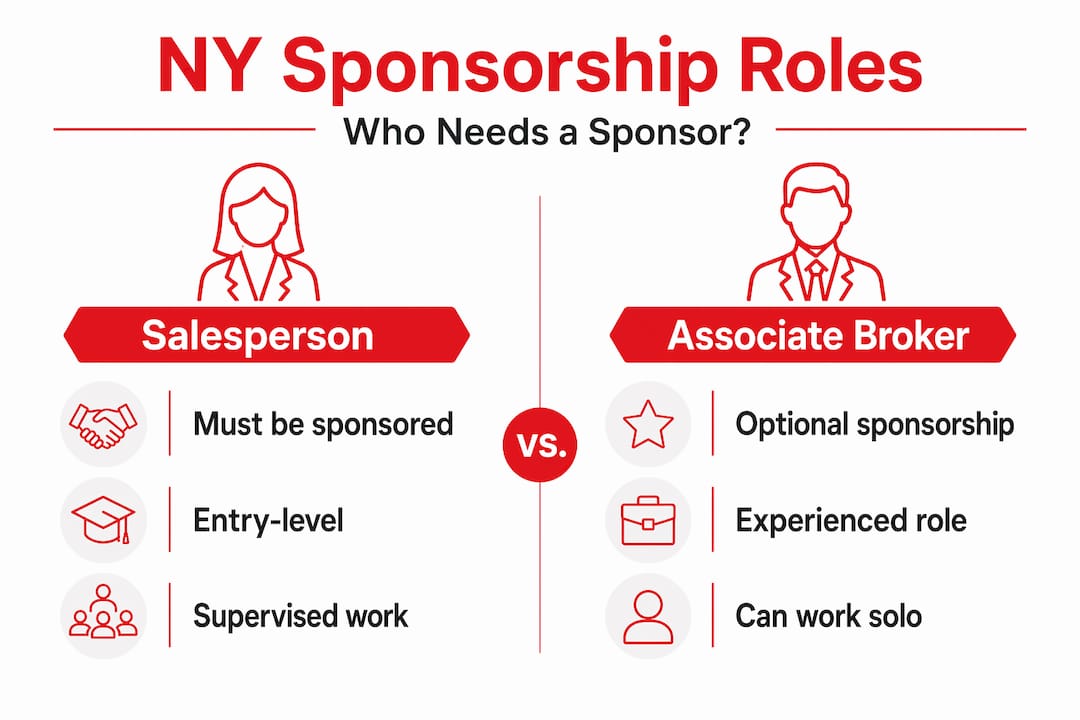
| Role | Sponsorship requirement | Key difference |
|---|---|---|
| Salesperson | Must be sponsored by a licensed broker to practice at all | Cannot operate independently under any circumstances |
| Associate broker | Must be sponsored by a principal broker to practice | Holds a broker license but works under another broker |
| Principal broker | No sponsorship required | Operates independently and can sponsor others |
Here is where many people get surprised. Obtaining a broker license does not require you to open your own brokerage. Associate brokers often continue working under a principal broker’s sponsorship, which gives them the credibility and earning potential of a broker license without the overhead of running a firm.
Why would a licensed broker choose to stay sponsored? The reasons are practical. Running a brokerage means managing compliance, carrying errors and omissions insurance at the firm level, recruiting agents, and handling administrative costs. Many associate brokers find it far more profitable to focus on production under an established firm than to take on the operational burden of ownership. It is a legitimate career strategy, not a fallback.
For salespersons, the path is straightforward. You need a sponsor to work. Period. For associate brokers, sponsorship is a choice with real financial and lifestyle implications worth thinking through carefully.
This is where how to get real estate sponsorship shifts from a legal question to a career strategy question. The broker you choose will shape your income, your skills, and your reputation in ways that go far beyond fulfilling a licensing requirement.
Sponsoring brokers are pivotal not just legally but as mentors and gatekeepers to deals. A broker with strong market connections can introduce you to clients and opportunities you would never find on your own. A broker who offers no training leaves you to figure everything out alone, which is a painful and expensive way to learn.
Here is what to evaluate before committing:
Choosing the right broker affects your mentorship opportunities, commission income, and long-term trajectory in ways most new agents do not fully anticipate until they are already locked into a bad situation.
Pro Tip: Ask every broker you interview this question: “What does your average first-year agent earn, and what support do you provide to help them get there?” Vague answers are a red flag.

The average salary for a New York City real estate agent is approximately $106,615 per year. That number is not guaranteed, and it varies enormously based on market, experience, and yes, the quality of your sponsoring broker relationship. Your broker choice is one of the most direct levers you have on that number in your first few years.
For a deeper look at evaluating brokers after you complete your education, the guide on finding the right broker covers the criteria in detail.
I have watched a lot of new agents treat sponsorship like a checkbox. Pass the exam, find any broker willing to sign the paperwork, get the license activated, and move on. That approach is a mistake I have seen derail careers that had real potential.
In my experience, the sponsoring broker relationship is the single most underestimated decision a new agent makes. The legal requirement gets all the attention, but the mentorship dimension is what actually determines whether you close your first deal in three months or three years. I have seen agents join large national franchises expecting training and get handed a desk and a phone book. I have also seen agents join small boutique firms and get daily coaching that accelerated their career by years.
What I have learned is that you should treat broker interviews like job interviews, because they are. Ask hard questions. Push for specifics on training, deal flow, and what happens when a transaction gets complicated. If a broker cannot answer those questions clearly, that tells you exactly what kind of support you will get when you actually need it.
The agents I have seen thrive in New York real estate almost always credit their first broker for giving them a foundation. The ones who struggled often describe their first broker as someone who was simply never available. That pattern is not a coincidence.
Your sponsoring broker is not just a legal formality. They are your first real teacher in this industry. Choose accordingly.
— Noelle
Getting clear on NY real estate license sponsorship is one thing. Being prepared to find and impress the right broker is another. At The Center for Real Estate Education (recareercenter.com), the pre-licensing programs are built specifically to get you ready for both. The curriculum goes beyond exam prep to cover the practical knowledge brokers actually look for in new agents, including how transactions work, how to communicate with clients, and how to carry yourself professionally from day one.
If you are still deciding how to complete your education, the comparison of online vs. in-person courses breaks down which format fits different schedules and learning styles. For those who want education that connects directly to broker placement, explore education that leads to job placement to see how Recareercenter supports students through the sponsorship process and beyond.
Real estate license sponsorship means a licensed New York broker formally affiliates with and supervises a salesperson, which is legally required to activate the salesperson’s license and allow them to practice.
Any individual holding an active New York real estate broker license, or a licensed brokerage firm in good standing with the NYSDOS, can sponsor a salesperson or associate broker.
Your license returns to inactive status. The previous broker must file a termination notice and your new broker must file an association notice through eAccessNY to reactivate your license.
Yes. A principal broker can operate independently without sponsoring agents. Sponsorship of salespersons and associate brokers is a choice for brokers, not a requirement.
No. Associate brokers in New York can continue working under a principal broker’s sponsorship without ever opening their own firm, which is a common and practical career path.