
An open enrollment real estate school is a state-approved institution that accepts new students year-round, with no fixed semester start dates or application deadlines. This model, formally called rolling admissions, lets you register and begin your pre-licensing coursework on your schedule. For career changers and working adults, that flexibility is the difference between starting this month and waiting until fall. Understanding what open enrollment real estate programs offer, and how they differ from traditional models, is the first step toward your real estate license.
Open enrollment in real estate education means no formal enrollment period exists. You register, pay tuition, and start your coursework on any day of the year. This is fundamentally different from community college or university programs that run on fixed academic calendars with limited seats per term.
One important clarification: the phrase “open enrollment” means something different in health insurance. Annual insurance open enrollment typically runs from november 1 through december 15 for many plans. Real estate school open enrollment has nothing to do with that window. The two terms share a name but describe completely different processes.
Real estate schools also distinguish between two course formats. Self-paced online courses let you log in and study whenever you want, completing modules on your own timeline. Scheduled live or virtual classes follow a set weekly calendar, but still allow rolling registration, meaning you can join the next available class rather than waiting for another session to begin. Both formats fall under the open enrollment model.
Pro Tip: Before registering anywhere, confirm the school holds approval from your state’s real estate commission. Non-approved providers’ hours do not count toward your license, and you will have to start over.

| Feature | Open enrollment school | Traditional semester school |
|---|---|---|
| Registration timing | Any time, year-round | Fixed start dates, limited windows |
| Course pacing | Self-paced or rolling live sessions | Cohort-based, fixed schedule |
| Waiting period | None | Weeks to months |
| Flexibility for working adults | High | Low to moderate |
| State approval required | Yes | Yes |
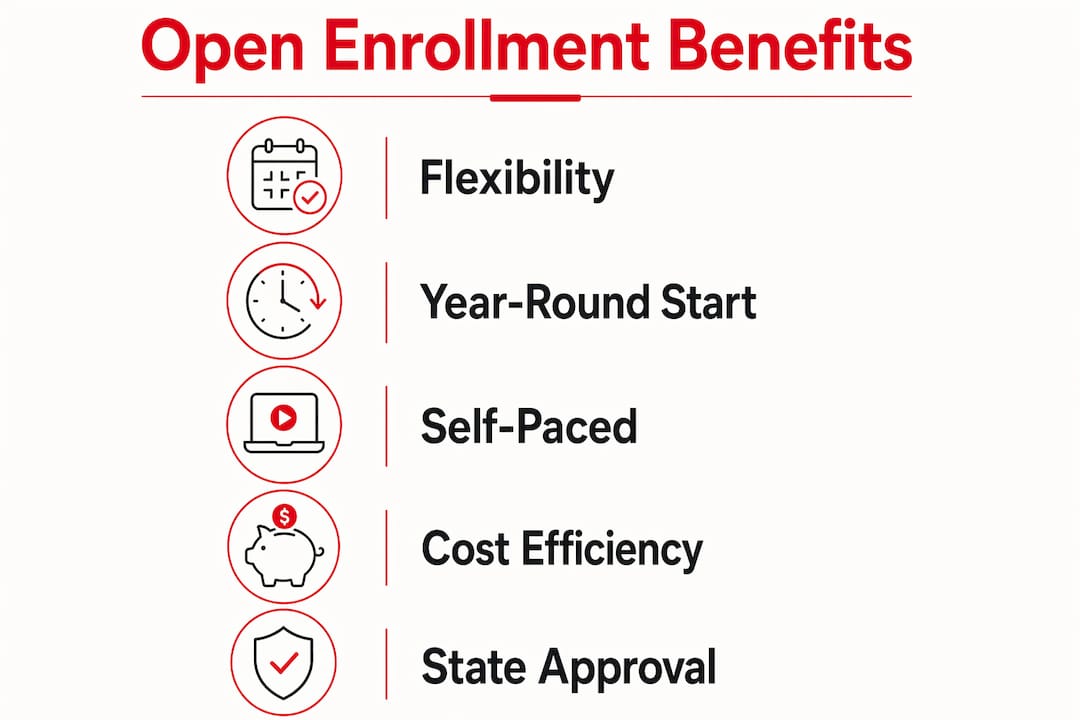
The biggest benefit is simple: you start when you are ready. There is no waiting for a fall cohort or a spring semester. If you decide on tuesday that you want a real estate license, you can be enrolled and studying by wednesday. That immediacy matters for career changers who cannot afford to lose months waiting for a program to open.
The benefits of open enrollment real estate education go beyond timing:
Startup costs for real estate education, exam fees, and license applications typically range between $500 and $1,650. That is a low barrier compared to most career transitions, and open enrollment schools often offer payment plans that make the cost even more manageable.
Pro Tip: Flexibility is only an advantage if you use it with discipline. Set a weekly study schedule on day one and treat it like a work commitment. Students who drift without a plan often hit state-mandated completion deadlines unprepared.
The real estate school admission process is straightforward. Here is how it works from start to finish.
The full real estate licensing timeline from enrollment to exam typically runs 4 to 12 weeks, depending on your state’s hour requirements and how quickly you study. That range reflects real variation: a 40-hour state moves faster than a 180-hour state.
One common pitfall is enrolling in a course without checking the completion deadline. Some states give you six months. Others give you one year. Rolling admission programs require close attention to these state-mandated timeframes. Miss the window and you may need to restart the course entirely.
| Step | What happens | Common pitfall |
|---|---|---|
| School selection | Verify state approval | Choosing a non-approved provider |
| Registration | Instant online access | Skipping deadline research |
| Coursework | Self-paced or scheduled or both | Drifting without a study plan |
| Course final exam | Online | Underestimating exam difficulty |
| State licensing exam | In-person at testing center | Scheduling too late after course |
State requirements vary more than most aspiring agents expect. Pre-licensing hours range from 40 hours in Michigan to 180 hours in Texas. That is a fourfold difference in required study time, and it directly affects how long your open enrollment program will take. Each state structures its requirements differently, and open enrollment schools must design their programs to meet each state’s specific rules.
The national first-time pass rate for licensing exams runs roughly 50–60%. That number reflects how seriously states take the licensing exam, and it underscores why course quality matters as much as flexibility.
| State | Required pre-licensing hours | Online coursework allowed | Notes |
|---|---|---|---|
| New Jersey | 75 hours | Yes | A common amount of hours |
| New York | 77 hours | Yes | Proctored final exam required |
| Florida | 63 hours | Yes | State exam pass rate is closely tracked |
| Texas | 180 hours | Yes | Highest requirement nationally |
| California | 135 hours (3 courses) | Yes | Three separate courses required |
Always verify your state’s current rules directly through the state real estate commission website. Requirements change, and a school’s website may not reflect the most recent updates. Recareercenter publishes state-specific guides, including a detailed Florida licensing step-by-step guide, to help students stay current.
Open enrollment real estate schools use rolling admissions to let aspiring agents start state-approved pre-licensing courses at any time, with no fixed semester dates or waiting periods.
| Point | Details |
|---|---|
| Rolling admissions model | You register and start coursework any day of the year, with no fixed semester dates. |
| State approval is non-negotiable | Only hours from state-approved schools count toward your license application. |
| State hours vary widely | Requirements range from 40 hours in Michigan to 180 hours in Texas. |
| Licensing exams stay in-person | Most states require the final licensing exam at an approved testing center regardless of online coursework. |
| Completion deadlines are real | State-mandated timeframes for finishing coursework apply even in self-paced programs. |
The term “open enrollment” trips people up more than almost any other phrase in real estate education. I have seen prospective students delay their entire licensing plan because they confused real estate school open enrollment with the annual health insurance open enrollment window. They assumed they had to wait for a specific registration period. They did not. Real estate schools accept students every day of the year.
The bigger trap is the opposite mistake: assuming that because a school is easy to access, it must be legitimate. I cannot overstate how often people complete dozens of hours of coursework through an unapproved provider and then discover none of it counts. The state commission does not care how much time you invested. If the school is not on the approved list, you start over. Checking the real estate license requirements for your state before you pay a single dollar is the single most protective step you can take.
For career changers specifically, open enrollment is genuinely transformative. You do not have to quit your job and wait for a semester. You can study at 10 p.m. after the kids are in bed. You can accelerate through material you already understand from a business background and slow down on legal concepts. The format respects your life. But it also demands that you respect the deadlines. Set your completion target date on day one, work backward, and build a weekly study schedule. The students who treat flexible access as a reason to drift are the ones who end up paying for a course extension.
— Noelle Friedman, Executive Director, Center for Real Estate Education
Recareercenter, the Alexander Anderson Center for Real Estate Education, offers state-approved pre-licensing programs in New Jersey, New York, Florida, and Pennsylvania with true open enrollment. You choose between self-paced online courses, live online sessions, and in-person classes, all built around your schedule rather than a fixed academic calendar.

Whether you are starting from scratch or adding a second state license, Recareercenter’s full course catalog covers pre-licensing, continuing education, and specialty certifications. The school holds ARELLO certification and active state approvals, so every hour you complete counts. If you are ready to stop waiting and start studying, explore your career path options and enroll today.
An open enrollment real estate school accepts new students year-round through rolling admissions, with no fixed semester start dates. You register, pay tuition, and begin approved pre-licensing coursework immediately.
Completion time depends on your state’s required hours and your study pace. Pre-licensing education typically takes 4 to 12 weeks, with states requiring anywhere from 40 to 180 hours of coursework.
Most states allow fully online pre-licensing coursework, but the state licensing exam and fingerprinting almost always require an in-person visit to an approved location.
Check your state’s real estate commission website directly. State commission websites list approved schools definitively, and hours from non-approved providers will not count toward your license.
Open enrollment programs use rolling admissions so you start anytime, while fixed-semester programs have set registration windows and cohort-based schedules. Open enrollment is better suited for working adults and career changers who need scheduling flexibility.