
Most people assume a real estate agent’s day is mostly property tours and handshakes. The reality of real estate agent daily responsibilities explained properly looks very different. Your day spans lead management, contract negotiations, marketing campaigns, client communication, and professional development — often all before lunch. Daily agent work blends revenue-generating activities with admin and marketing in ways that can overwhelm unprepared agents. This guide breaks down each phase of the day so you can enter or improve your practice with clear expectations and a plan that actually works.
| Point | Details |
|---|---|
| Morning admin drives the day | Reviewing leads, emails, and your schedule before 9 a.m. sets the tone for client responsiveness and productivity. |
| Client work and admin are separate modes | Mixing showings with contract tasks leads to costly errors. Treat them as distinct blocks in your calendar. |
| Marketing is a daily non-negotiable | Agents who skip marketing during busy transaction periods lose pipeline momentum within weeks. |
| Ethics and education are ongoing | NAR Code of Ethics training and continuing education directly protect your license and your reputation. |
| Lead response speed matters enormously | Contacting a new lead within five minutes dramatically increases your chance of converting them into a client. |
The first thing to understand about the real estate agent work description is that it has no single shape. Your day shifts based on your client load, market activity, and where you are in active transactions. That said, experienced agents build routines with intention rather than reacting to whatever lands in their inbox first.
A typical day starts with morning admin including checking emails, voicemails, and reviewing the schedule for appointments. This is not busywork. It is the foundation of your responsiveness, and clients notice when you stay ahead of communication.
Strong agents treat the first 60 to 90 minutes of the day as protected time. Here is what that window should cover:
Pro Tip: Responding to new leads within five minutes is a documented success factor for agents. Block a dedicated fast-response window at the start of each day rather than treating lead follow-up as something you get to between appointments.
This is the part of the job most people picture when they think about what real estate agents do daily. It is also the part that generates your income directly. But preparation and follow-through matter as much as the showing itself.
Before any property tour, you should review the listing details, neighborhood comparables, HOA rules, and any seller disclosures. Walking into a showing without that context makes you look unprepared and costs you client trust. During the tour, your job is not just to open doors. You are reading body language, fielding objections, gauging buyer enthusiasm, and mentally cataloging which features align with what the client told you they wanted two weeks ago.
Agents juggle roles as marketer, negotiator, project manager, and problem solver at the same time, and property showings are where those roles collide. A single 45-minute tour requires you to act as an educator, a listener, a salesperson, and a logistics coordinator.

Managing multiple clients simultaneously is one of the hardest skills to develop. Consider a practical scenario: you have a buyer tour at 10 a.m., a seller check-in call at noon, and a new buyer consultation at 3 p.m. Each of those clients expects your full attention, but each also requires a completely different mental approach and set of prepared materials.
Here are the client-facing tasks that appear most often in a typical agent’s afternoon:
Pro Tip: For new real estate agent advice on managing multiple client needs without dropping the ball, build a simple client contact log in your CRM that tracks the last touchpoint for every active client. Set an automatic reminder if 72 hours pass without contact.
Once the showings wrap up, the real administrative and legal work begins. This phase of the agent’s day is where deals are made or lost, and where attention to detail separates professionals from people who get lucky occasionally.
The daily tasks of real estate agents in the afternoon typically follow this sequence:
Afternoons focus on contract management and coordination that is critical for keeping deals on track. This is not glamorous work, but it is where your professional reputation is built or damaged most quickly.
Pro Tip: Separating client work and administrative work daily is critical for avoiding missed deadlines. Block 90-minute windows specifically for transaction admin where you do not take calls or schedule showings. You will make fewer errors and move faster.
Here is the trap most agents fall into: when business is good, marketing stops. Then the pipeline dries up three months later and they wonder why. The most consistent performers treat marketing as a daily responsibility, not a rainy-day activity.
Lead generation, relationship nurturing, and AI visibility are keys to sustainable long-term growth, and they require regular effort. A single week without outreach can cost you momentum that takes a month to recover.
The table below compares reactive marketing (what most agents do) with proactive marketing (what top agents do):
| Approach | Description | Outcome |
|---|---|---|
| Reactive marketing | Post only when business is slow or after a big sale | Inconsistent pipeline, feast-or-famine cycles |
| Proactive marketing | Daily social posts, weekly emails, scheduled outreach calls | Steady lead flow, stronger referral network |
| Geographic farming | Regular mailers and community presence in a target neighborhood | Name recognition that converts over 12 to 18 months |
| Sphere-of-influence outreach | Monthly check-ins with past clients and personal contacts | Referral business that costs almost nothing to generate |
Your marketing strategy as an agent should include at minimum a weekly email to your database, two to three social media posts with local market content, and one phone call or personal message to a past client or warm contact. That takes about 45 minutes a day when batched properly.
CRM tools are what make this sustainable. When you log every interaction, set automated follow-up sequences, and tag contacts by readiness, you stop relying on memory and start building a machine that surfaces the right conversation at the right time.
The agent responsibilities in real estate extend beyond transactions. Every licensed agent operates under ongoing obligations that directly affect their ability to practice and the level of trust clients place in them.
Agents must complete Realtor Code of Ethics training at least once every three years. That training covers duties to clients, duties to the public, and duties to other Realtors. It is not just a compliance requirement. It shapes how you handle dual agency situations, disclosure obligations, and competitive behavior in ways that protect both you and your clients.
Continuing education requirements vary by state but are non-negotiable for license renewal. Smart agents treat CE not as a box to check but as an opportunity to develop skills in areas like property management, investment analysis, or commercial transactions that expand their income potential.
Here is how professional development fits into a realistic weekly schedule:
Early-career success depends more on patient prospecting and database building than on rushing to close listings. Professional development is part of that patient investment.
I have watched a lot of agents burn out in their first two years, and almost every time, the root cause is the same: they never separated their working modes. They answer client texts during contract reviews, draft emails during showings, and then wonder why they keep making errors or losing clients who felt ignored.
What I have learned is that time management and discipline are not soft skills in this business. They are survival skills. The agents who build sustainable careers treat their calendar like a business asset, not a suggestion.
The other thing most articles will not tell you: marketing feels unproductive until it suddenly is not. I have seen agents post consistently for six months with almost no visible return, then land three referrals in one week because someone remembered seeing their name repeatedly. Consistency compounds in ways that are invisible until they are not.
If you are just starting out, treat your first year as building your real estate career through prospecting, database growth, and professional habits rather than chasing fast closings. The agents who survive are the ones who showed up every day when nothing was happening yet.
— Noelle
If reading through all of this made the job feel more complex than you expected, that is actually a good thing. Understanding what you are signing up for is the first step toward preparing for it properly.

At Recareercenter, the programs are built around real-world agent workflows, not just licensing exam prep. Whether you are studying for your first license or looking to sharpen your negotiation and marketing skills as a working agent, the center offers flexible real estate training that fits around the demands of an active schedule. From pre-licensing to continuing education courses and specialty certifications in areas like commercial real estate and property management, you can build the exact skill set the daily job actually requires. Browse the full real estate course catalog to find the program that matches where you are in your career right now.
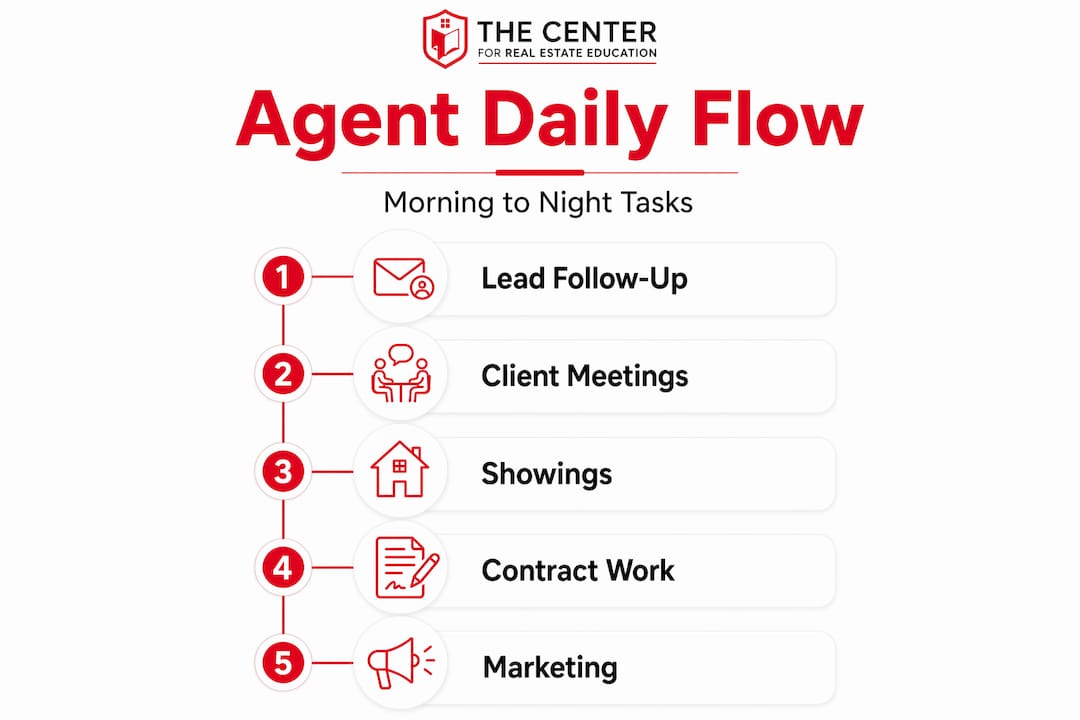
A typical day includes morning lead follow-up and schedule review, client meetings and property showings in the midday hours, and contract drafting, negotiations, and third-party coordination in the afternoon and evening. Marketing and CRM updates weave throughout the entire day.
Most active agents work eight to ten hours a day, though evening and weekend availability for clients is common. The schedule is flexible but rarely light, especially during active transaction periods.
Lead follow-up, client communication, transaction management, and consistent marketing are the four duties that most directly affect income and client retention. Letting any one of them slip for more than a few days creates problems that are difficult to recover from quickly.
Responding within five minutes significantly improves conversion rates. Treating lead response as a dedicated daily task rather than a background activity is one of the most impactful habits an agent can build.
CE requirements vary by state, but most states require periodic continuing education for license renewal. NAR also requires Code of Ethics training at least once every three years for Realtor members.