
Most new agents think onboarding is just signing a few forms and getting a desk. That belief is expensive. Understanding what is real estate agent onboarding training means recognizing it as a structured, multi-phase process covering legal compliance, technology setup, and production readiness. Nearly 87% of new agents leave the industry within five years, and weak onboarding is a primary driver of that loss. If you are a new agent or a broker building a team, knowing exactly what this process involves can make the difference between a thriving career and an early exit.
| Point | Details |
|---|---|
| Onboarding spans 60 to 90 days | The process covers legal compliance, technology setup, and production training before an agent closes their first deal. |
| Legal documents come first | The Independent Contractor Agreement must be signed on Day 1 to establish 1099 status and protect all parties. |
| Technology sequence matters | MLS and lockbox access must be activated before CRM setup because agents need property access before lead management. |
| Onboarding differs from ongoing training | Onboarding focuses on first-deal readiness; ongoing training builds long-term skills and career performance. |
| Pre-boarding reduces early dropout | Engaging agents before Day 1 with clear expectations and resources significantly cuts early attrition. |
A comprehensive onboarding program typically runs 60 to 90 days and breaks into three distinct phases: legal compliance, technology setup, and production ramp-up. Each phase builds on the last. Skip one, and the entire structure becomes unstable.
Phase 1: Legal compliance
This phase is where most agents and brokerages stumble. The Independent Contractor Agreement must be executed on Day 1. It establishes your 1099 independent contractor status and protects the brokerage from liability the moment you begin any activity. Many new agents assume transferring their license is the only legal step that matters. It is not. Without the ICA signed before commissions or client work begin, there is real legal ambiguity for everyone involved.

Beyond the ICA, compliance training includes Fair Housing law, agency disclosure forms, and the NAR Code of Ethics. Starting in January 2025, all NAR members must complete at least 2 hours of Fair Housing and Anti-Bias training every three years, with the first deadline set for December 31, 2027. Noncompliance means membership suspension. These are not optional checkboxes.
Phase 2: Technology setup
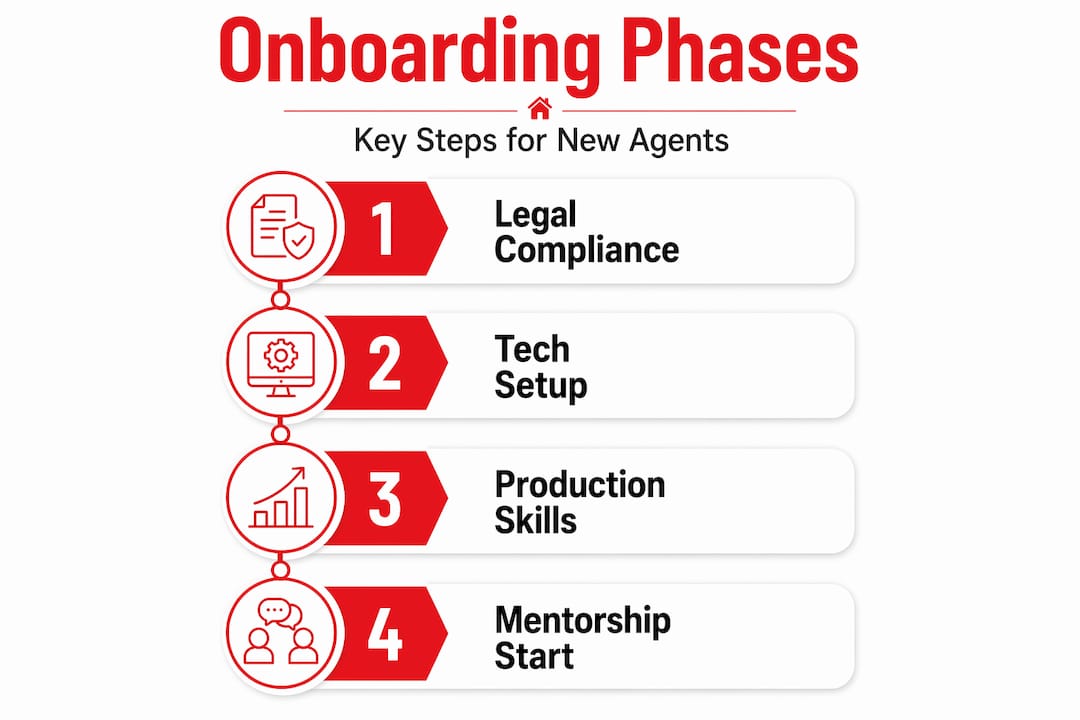
The order of technology setup is not arbitrary. MLS and lockbox access must be activated before CRM setup because an agent has to be able to access and show properties before they can worry about managing leads in a database. Skipping transaction platform training is another common error that creates liability and causes deal delays.
New agents should expect to learn their brokerage’s MLS platform, electronic lockbox system, transaction management software, and CRM during this phase. Many brokerages now deliver and track this training through Learning Management Systems.
Phase 3: Production ramp-up
Pro Tip: Ask your brokerage for a written onboarding checklist on your first day. If they do not have one, that tells you something important about how they operate.
These two things are often confused, and the confusion costs agents real growth time. Onboarding lasts 4 to 8 weeks and has one specific goal: getting you to your first deal safely. Ongoing training is a continuous process focused on performance improvement, market specialization, and long-term career development. The scope and purpose are completely different.
| Feature | Onboarding training | Ongoing training |
|---|---|---|
| Duration | 4 to 8 weeks | Continuous throughout career |
| Primary goal | First deal readiness | Skill development and performance |
| Content focus | Legal, technology, and production basics | Market specialization, advanced negotiation |
| Delivery method | LMS, checklist, mentor shadowing | Coaching sessions, workshops, certifications |
| Success metric | First deal completed | GCI growth, client retention, referrals |
Another distinction worth understanding is the difference between training and coaching. Training builds repeatable skills; coaching is personalized and focuses on applying those skills to real-world challenges the agent is facing right now. Strong real estate training programs integrate both. Training gives you the playbook. Coaching helps you run the plays when the defense shifts.
Brokerages that rely on performance data to guide training see better results than those operating on fixed schedules and generic content. If your training feels like it has nothing to do with your actual daily problems, that is a data-driven design failure, not just a personality mismatch.
Pro Tip: When evaluating a brokerage, ask specifically how they distinguish their onboarding program from their ongoing training. A clear, detailed answer is a strong signal of a serious organization.
The new agent onboarding process fails more often from negligence than from malicious intent. Many common mistakes come from treating training as a purely administrative exercise rather than the transformational foundation it needs to be. Here is what goes wrong most often:
“Onboarding that focuses only on information transfer without addressing agent mindset, daily disciplines, and business fundamentals produces agents who are licensed but not prepared.”
The deeper problem is a misconception about what successful onboarding looks like. Many brokers measure success by whether an agent showed up on Day 1 and signed everything. Real success is whether that agent closes their first deal within 60 days and has the habits to build a sustainable pipeline afterward.
Getting the most from the new agent onboarding process requires deliberate effort on the agent’s side, not just the brokerage’s side. Here is how to approach it strategically.
Pro Tip: Print out your onboarding milestones and post them somewhere visible in your workspace. Agents who track progress weekly close their first deals faster than those who treat onboarding as background noise.
I have seen a lot of onboarding programs across different brokerage models, and I will tell you honestly: most of them fail new agents by confusing activity with preparation.
The biggest flaw I keep seeing is the illusion problem. New agents often walk in believing real estate is primarily a relationship business, and the right attitude will carry them through. That belief is not wrong, exactly. It is incomplete. Successful onboarding addresses those illusions directly and builds purpose, momentum, and essential daily disciplines in their place. When brokerages skip that step, agents hit their first hard month and have no framework for pushing through.
What actually works is teaching the “why” and the “how” together, not just delivering facts. When an agent understands why the ICA matters legally, why the technology sequence is ordered the way it is, and why daily prospecting habits determine their income ceiling, they follow through. When they are just handed a checklist, they check boxes and drift.
I also think independent brokers consistently underestimate how competitive they can be on training. You do not need a franchise’s budget to build a training program that beats the big names. You need proven systems, accountability, and genuine investment in teaching agents what this business actually requires. That is something any committed broker can build. For new agents navigating the process, the best real estate agent training tips I can offer are this: engage earlier than you think you need to, ask more questions than you think are appropriate, and treat your first 90 days like the most important professional development period of your career. Because it is.
— Noelle
Understanding the onboarding process is one thing. Having the right educational foundation underneath it is another. Recareercenter offers flexible, career-focused real estate education built around practical application, not just exam prep. Whether you are entering the industry for the first time or transferring your license to a new state, programs are designed to fit your schedule across New Jersey, New York, Florida, and Pennsylvania. Live online, in-person, and self-paced options let you learn the way that actually works for your life. If you are serious about starting strong, explore training built for real careers and see how structured education connects directly to long-term performance.
Real estate agent onboarding training is a structured program covering legal compliance, technology setup, and production readiness that prepares a new agent to complete their first deal safely. It typically spans 60 to 90 days and is distinct from ongoing professional development.
Most onboarding programs run 4 to 8 weeks for initial first-deal readiness, with the full structured phase extending up to 90 days depending on the brokerage’s program depth and the agent’s prior experience.
The Independent Contractor Agreement is the most critical document and must be signed on Day 1. Additional requirements include license transfer confirmation, NAR Code of Ethics completion, and state-specific disclosure training.
Onboarding focuses on getting a new agent ready for their first deal through compliance, technology, and production basics. Ongoing training is continuous skill development focused on market specialization, advanced negotiation, and long-term performance growth.
No. Experienced agents transferring to a new brokerage still need to complete that brokerage’s legal compliance and technology onboarding fully. Prior experience does not override legal documentation requirements or platform-specific training.