
A real estate bridge course helps licensed real estate professionals meet the additional education requirements for another state. It fills the gap between the education you have already completed and what the new state requires.
“Bridge course” is not an official term used by most state real estate commissions. It is simply a practical way to describe supplemental education that helps you move from one state’s licensing requirements to another’s.
A real estate bridge course is not a standard regulatory term. State real estate commissions do not typically list “bridge course” as an official education category. What agents call a bridge course is usually a preparatory or supplementary program designed to cover state-specific content gaps for license reciprocity, mutual recognition, or broker upgrades.
These courses exist because getting licensed in another state is rarely a simple transfer. New York, for example, may grant an education waiver to an applicant who has already completed qualifying real estate education in another state. However, the applicant still has to meet New York’s licensing requirements, which may include completing any missing New York-specific education, submitting documentation, and passing the New York State licensing exam.
A bridge course helps fill those education gaps and prepares you for the state-specific material you still need to know. It does not replace the state exam, the waiver application, or any other licensing requirements.

Some bridge programs also apply to license type upgrades, such as moving from a sales associate license to a broker license without repeating the full pre-license curriculum. These supplemental upgrade programs must come from approved providers to satisfy licensing board rules. Taking a course from an unapproved provider means the hours will not count.
Here is what a typical education waiver / bridge course licensing path looks like when a bridge course applies:
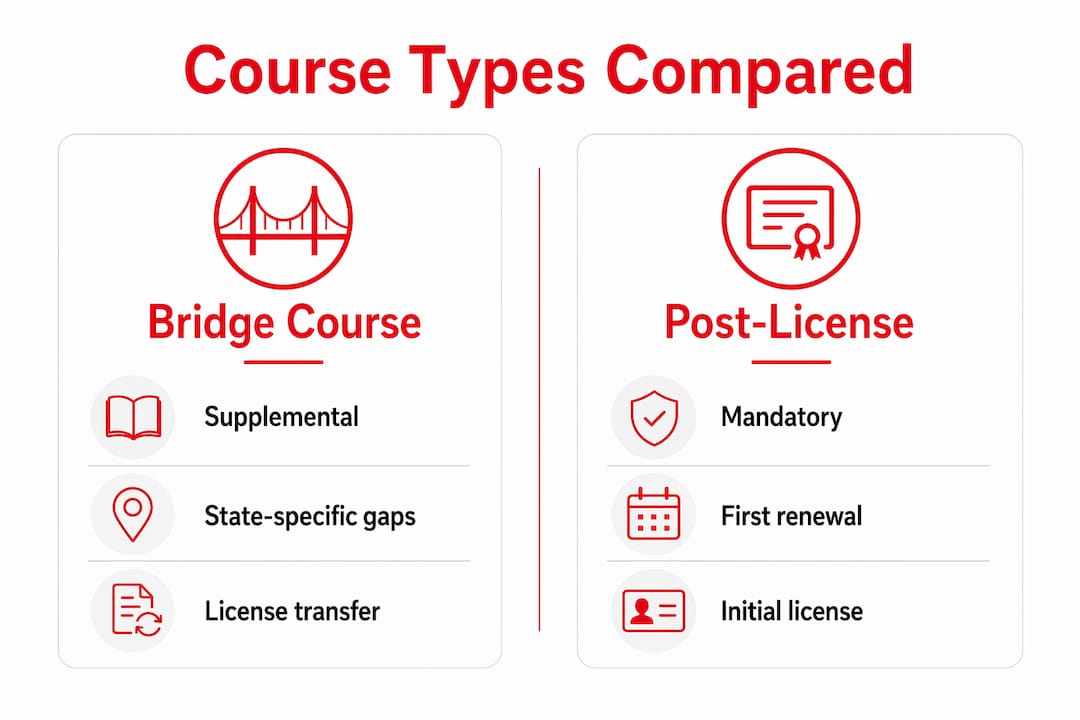
Agents frequently confuse these three course types. Each serves a different regulatory purpose, and mixing them up can cost you your license.
Post-license education is a mandatory first-renewal requirement. For example, Florida Statute 475.17 requires sales associates to complete a 45-hour post-license course before their first renewal, typically within 18–24 months of initial licensure. Missing this deadline makes the license null and void. The agent must then restart the entire pre-license process and pass the state exam again. Post-license education is not optional and cannot be substituted with a bridge course or continuing education.
Continuing education applies after the first renewal cycle. Florida’s 14-hour CE renewal package includes 3 hours of Core Law, 3 hours of Ethics, and 8 hours of specialty content. This is separate from post-license education and from bridge courses entirely. It is the ongoing maintenance requirement every active licensee must meet at each renewal.
Bridge courses are supplemental. They are not mandatory for license maintenance. They apply specifically when you are seeking a license in a new state or upgrading your license type. The table below shows how these three course types compare directly.
| Category | Purpose | Timing | Typical Hours | Regulatory Impact |
|---|---|---|---|---|
| Bridge course | Fills state-specific content gaps for reciprocity or upgrades | Before applying for new state license | Varies by state and program | Prepares for state law exam; may satisfy partial education requirements |
| Post-license education | Mandatory first-renewal requirement | Within 18–24 months of initial license | 45 hours (Florida example) | License becomes null and void if missed |
| Continuing education | Ongoing license maintenance | Each renewal cycle after first | 14 hours (Florida example) | License lapses if not completed by renewal deadline |
Choosing the right program starts with knowing exactly what your target state requires. Many providers market courses as bridge programs when they are actually general exam prep with no official state approval. That distinction costs agents real time and money.
Follow these steps before committing to any course:
Ask every provider these questions before enrolling:
The biggest misconception is that completing a bridge course automatically transfers your license. It does not. Education is only one component of the process. Administrative requirements like fingerprinting, official license history certification, and exam scores must all be submitted and approved separately.
A second common mistake is treating a bridge course as a substitute for post-license education. These are not interchangeable. Post-license education is a state-mandated requirement tied to your initial license. Missing it invalidates your license entirely, regardless of any bridge coursework you have completed.
Agents often underestimate the administrative complexity involved in license transfers. Education is only one component among fingerprinting, exam, and license history documentation requirements.
Here are the most frequent pitfalls agents encounter:
The cleanest way to avoid these errors is to map out every requirement before you start. Get the full checklist from the target state’s commission, not from a course provider’s marketing page.
A real estate bridge course fills state-specific education gaps for license reciprocity or upgrades, but it does not replace exams, paperwork, or mandatory post-license education requirements.
| Point | Details |
|---|---|
| Bridge course definition | A supplemental program covering state-specific content gaps, not an official regulatory category. |
| Education is one step | License transfers also require a state law exam, fingerprints, and license history certification. |
| Post-license is mandatory | Missing Florida’s 45-hour post-license deadline makes the license null and void. |
| Choose providers carefully | Confirm state approval, ARELLO certification, and course eligibility before enrolling. |
Agents who struggle most with license transfers are the ones who start with the education and skip the paperwork research. I have seen experienced professionals complete a full bridge course only to discover the provider had no state approval code. The course was well-taught and genuinely useful. It just did not count for anything official.
The second pattern I see constantly is agents underestimating how long the administrative side takes. Fingerprint processing, license history requests, and commission reviews can stretch weeks beyond what anyone expects. Starting education and paperwork in parallel, not sequentially, is the move that experienced agents make.
State regulations also shift. What qualified as a bridge course pathway in 2024 may have different requirements in 2026. Reciprocity agreements between states change, and so do the approved course lists. Checking the commission’s current approved provider list every time you start a new licensing process is not overcautious. It is the only way to avoid wasted effort.
The agents I have seen build multi-state practices efficiently treat education planning as a career strategy, not a compliance checkbox. They map their target states, identify the reciprocity paths, and select approved courses that serve multiple goals at once. That kind of proactive planning is what separates agents who expand their business from those who get stuck in paperwork loops.
— Noelle Friedman, Executive Director, Center for Real Estate Education
Recareercenter, operating as the Alexander Anderson Center for Real Estate Education, offers state-approved courses across New Jersey, New York, Florida, and Pennsylvania. Programs cover pre-licensing, post-licensing, continuing education, and courses designed for agents seeking licenses in additional states.

Whether you need to meet New Jersey’s and New York’s pre-licensing requirements, Florida’s post-license requirement, prepare for a state law exam as part of a reciprocity application, or get licensed in another state, Recareercenter provides live online, in-person, and self-paced formats to fit your schedule. The school holds ARELLO certification and state approvals, so every course hour counts toward your actual licensing requirements. Browse the full catalog of real estate courses to find the right program for your next licensing goal.
A real estate bridge course is a supplemental educational program that prepares licensed agents to meet state-specific requirements for license reciprocity, mutual recognition, or license type upgrades. It is not an official regulatory category but a practical term for courses that fill content gaps between states.
No. Completing a bridge course does not transfer your license. You still need to pass a state-specific law exam, submit fingerprints, and provide official license history certification to the target state’s commission.
Post-license education is a mandatory state-required course tied to your initial license renewal. Missing it invalidates your license. A bridge course is supplemental education for reciprocity or upgrades and does not substitute for post-license requirements.
Bridge courses rarely waive all exam requirements. Most prepare you for the state-specific law section only. Some states offer partial exam waivers through reciprocity agreements, but you must confirm eligibility with the state commission directly.