
The real estate national exam section is the standardized portion of the licensing exam that tests universal real estate principles every agent must know, regardless of which state they intend to practice in. This section exists alongside a state-specific portion, and both must be passed independently to earn a license. Administered through testing providers like PSI or Pearson VUE, the national section covers property ownership, contracts, agency relationships, finance, fair housing, and ethics. Understanding what is real estate national exam section content, how it is scored, and how it differs from the state portion gives you a real advantage before you sit down at the testing center.
The national portion tests the fundamental knowledge that applies to real estate practice across all 50 states. These are not abstract concepts. They are the building blocks every agent uses from day one on the job.
The major content areas include:
The national portion covers property law, contracts, agency, finance, appraisal, and fair housing. These topics represent the non-negotiable knowledge base for any licensed agent. A question on fiduciary duties, for example, applies whether you work in New Jersey, Florida, or California.
Exam questions are not purely definitional. The exam tests knowledge, application, and analysis to ensure candidates can protect the public from day one. That means you will see scenario-based questions that ask you to apply a concept, not just recall it.

Pro Tip: When you study fair housing, go beyond memorizing the seven protected classes. Practice applying the law to specific scenarios, such as a landlord refusing to rent to a family with children, so you can answer application-level questions confidently.
The national exam section follows a consistent format across most states. Knowing the mechanics helps you manage your time and set realistic expectations.
The independent scoring rule is the detail most candidates overlook. A strong national score does not compensate for a failing state score, and vice versa. You must clear both thresholds separately to pass the full exam.
The cognitive level breakdown matters for your study plan. A major topic area might include two knowledge questions, five application questions, and three analysis questions. Memorizing definitions alone will not get you to 70%. You need to practice applying concepts to real-world scenarios.
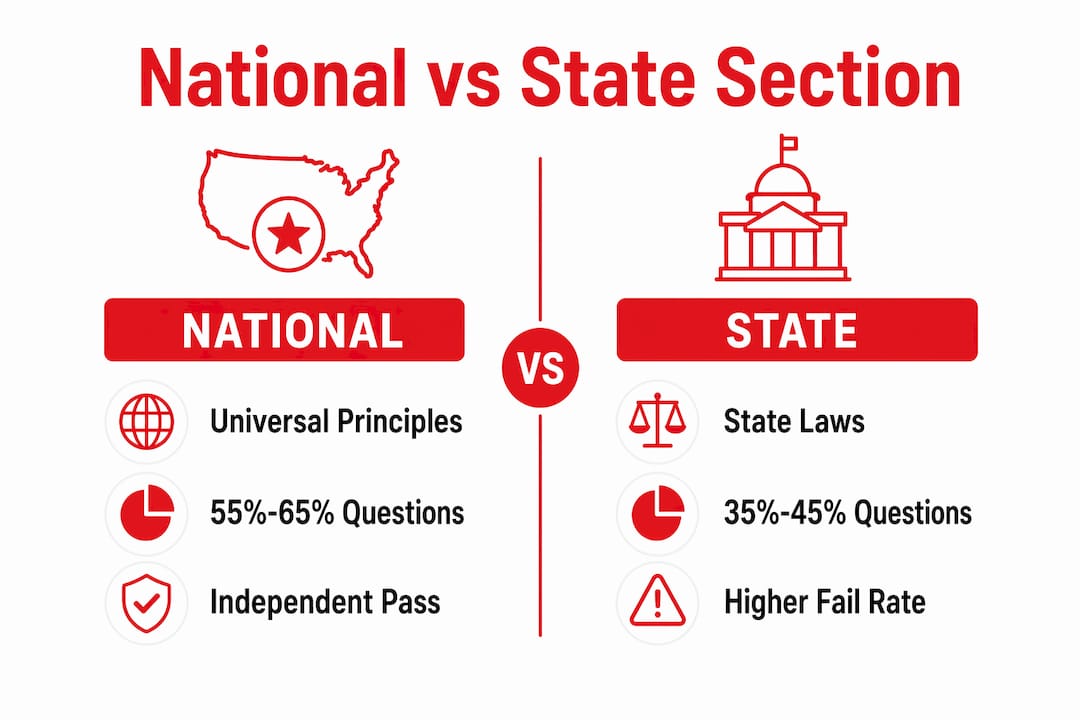
The two sections test fundamentally different knowledge, and treating them as interchangeable is one of the most common preparation mistakes.
| Feature | National section | State section |
|---|---|---|
| Content focus | Universal real estate principles | State-specific laws and regulations |
| Exam weight | 55%–65% of total exam | 35%–45% of total exam |
| Question count | 80–100 questions | 30–80 questions |
| Study materials | National content outlines, universal guides | State statutes, license law, commission rules |
| Scoring | Independent passing threshold | Independent passing threshold |
The national portion accounts for 55%–65% of the total exam. Its larger share reflects the depth of universal knowledge required. The state section, while smaller, covers material that is often more granular and less intuitive.
Candidates fail the state exam more often than the national exam. The reason is straightforward: state-specific statutes and commission regulations require memorizing details that do not appear in any national study guide. New Jersey’s license law differs from Florida’s in meaningful ways, and neither is tested on the national portion.
Pro Tip: Do not let the national section’s larger question count fool you into spending all your study time there. Allocate dedicated hours to your state’s specific license law, commission rules, and disclosure requirements. These details are where most candidates lose points.
Understanding the difference also changes how you prepare for your real estate exam. National content rewards conceptual understanding and scenario practice. State content rewards precise memorization of statutes and deadlines.
Focused preparation beats general review every time. The candidates who pass on the first attempt treat the national and state sections as two separate study projects.
Pro Tip: After each practice test, categorize your wrong answers by topic area. If you miss three contract questions and two finance questions, those are your priority topics for the next study session. Random review wastes time that targeted review would use well.
The real estate licensing exam is designed to protect consumers by ensuring agents understand essential knowledge and professional responsibilities. That framing is useful for studying. Every question exists because a real agent, in a real transaction, needs to know the answer to protect their client.
Recareercenter offers pre-licensing programs across New Jersey, New York, Florida, and Pennsylvania with live online, in-person, and self-paced options. Candidates who study with structured, instructor-supported programs covering national exam content enter the testing center with a clear advantage over those who rely on self-directed review alone.
The national real estate exam section tests universal principles across property ownership, contracts, agency, finance, fair housing, and ethics, and requires an independent passing score of 70–75% to advance toward licensure.
| Point | Details |
|---|---|
| Two independent sections for some states | For some states, both national and state sections must be passed separately; one strong score cannot offset a weak one. |
| National section scope | Covers 80–100 questions across property law, contracts, agency, finance, valuation, and fair housing. |
| Cognitive levels tested | Questions span knowledge, application, and analysis; memorization alone is not enough to pass. |
| State section is harder for most | Candidates fail the state portion more often because it demands precise knowledge of local statutes. |
| Targeted prep wins | Separating national and state study materials and using topic-specific practice tests improves pass rates. |
The national exam section gets treated as the “main event” by most candidates I have worked with, and I understand why. It is bigger, broader, and covered by more study guides. But that framing creates a dangerous blind spot.
The national portion tests concepts you will actually use every day as an agent. Understanding fiduciary duty, fair housing law, and contract essentials is not just exam prep. It is the professional baseline. Candidates who genuinely understand these concepts, rather than memorizing answers, carry that knowledge into every transaction they handle after licensing.
What I have seen consistently is that candidates who struggle on the national section are usually weak on application questions, not knowledge questions. They can define “dual agency” but freeze when a scenario asks them to identify whether a specific situation creates a conflict of interest. The fix is not more reading. It is more scenario practice.
The other mistake I see is treating the national section as a hurdle to clear before the “real” work of studying state law. The national content is the real work. It builds the mental framework that makes state-specific rules make sense. When you understand why agency disclosure exists as a universal principle, your state’s specific disclosure form becomes much easier to learn.
My honest advice: spend the first half of your study time mastering national content at the application and analysis level. Then shift to state-specific material with that conceptual foundation already in place. You will find the state content clicks faster, and your overall confidence going into the exam will be noticeably higher. Check out top questions new students ask if you are still building your study plan from scratch.
— Noelle Friedman, Executive Director, Center for Real Estate Education
Passing the national real estate exam section starts with the right preparation, and that means structured coursework built around the actual content areas tested.

The Center for Real Estate Education offers pre-licensing courses in New Jersey, New York, Florida, and Pennsylvania with flexible formats including live online, in-person, and self-paced options. Programs cover all major national exam topics, including property ownership, contracts, agency, finance, fair housing, and ethics, alongside state-specific content. Instructors provide direct support, not just recorded lectures. Whether you are starting fresh or returning to finish a course, Recareercenter’s real estate education courses give you a clear path from enrollment to exam day. Explore the full course catalog and find the format that fits your schedule.
The real estate national exam section is the standardized portion of the licensing exam that tests universal real estate principles, including property law, contracts, agency, finance, and fair housing, applicable across all states.
The national section typically contains 80–100 questions. Five of those are unscored pretest items that are indistinguishable from the rest.
Most states require a passing score of 70–75% on the national section. This threshold must be met independently from the state section score.
The national portion takes approximately 150 minutes when taken alone. That works out to roughly 90 seconds per question.
The national section is broader, but candidates fail the state section more often. State exams require precise knowledge of local statutes and commission regulations that national study guides do not cover.