
Most real estate agents spend their first year memorizing scripts that sabotage the very trust they need to close deals. Understanding the real estate sales training methodology explained in modern coaching circles reveals why: traditional pressure-based tactics have been replaced by psychology-first, consultative frameworks that actually convert. Psychology-first scripts convert 31% better than traditional approaches, and structured role-play cuts closure time by 18%. If you are serious about improving your sales performance, the methodology you train with matters far more than the number of hours you log.
| Point | Details |
|---|---|
| Psychology-first training converts better | Consultative, emotion-aware approaches outperform scripted pressure tactics by a measurable margin. |
| Role-play beats passive learning | 70% of sales learning comes from real-world practice, not lectures or reading. |
| Ethics training is a sales tool | Deep knowledge of NAR compliance separates top agents from average ones and builds client trust. |
| Customized training accelerates results | Experienced agents ramp up faster when training skips basics and focuses on market-specific strategies. |
| Technology multiplies training impact | AI role-play platforms and microlearning tools help busy agents practice consistently and retain skills longer. |
The biggest misconception new agents carry into their first year is that selling real estate is about persuasion. It is not. The agents who last, and who build referral-based businesses, have made a fundamental shift. They became consultants. Leading agents have moved from gatekeepers to educators, focusing on serving clients through information rather than pushing them toward a decision.
There are three core methodologies worth understanding deeply.
The Teach to Sell Method
This framework, popularized by educators and adopted by top-performing brokerages, treats the sales conversation as a teaching moment. You explain market data, walk clients through their options, and let the logic of the situation guide the decision. Brands like Patagonia and HubSpot have used teaching-based selling approaches to generate predictable revenue without pressure. In real estate, this means arriving at a listing appointment with a market analysis, not a closing script.
Psychology-First Consultative Techniques
This approach trains agents to recognize the emotional state behind a client’s question before answering it. A buyer who says “we’re just looking” is not disengaged. They are afraid of making a mistake. Agents trained in psychology-first methods learn to respond to the fear, not the statement. Objection handling frameworks built around Acknowledge, Clarify, and Redirect treat every objection as a signal that the client is still engaged and seeking reassurance. That mindset shift alone moves agents from average to high-performing.
Structured Role-Playing and Simulation
Role-play is the training method most agents resist and most coaches insist on. The reason coaches win that argument: active learning builds stronger neural pathways than passive study, producing better skill retention. A well-structured role-play session runs an agent through a specific scenario, like handling a price objection on a second showing, and requires them to stay in the conversation through discomfort. That is exactly the muscle that closes deals.

Pro Tip: When first introducing role-play to your practice routine, record the session on your phone. Watching yourself back is uncomfortable, but it reveals filler words, defensive body language, and missed listening cues that you cannot identify in the moment.
A common pitfall when adopting these methodologies is treating them as scripts in disguise. The Teach to Sell method fails when agents memorize talking points instead of genuinely understanding the market data they are presenting. Psychology-first training fails when agents perform empathy rather than practicing it. The methodology only works when it changes how you think, not just what you say.
The gap between how most agents are trained and how top agents actually operate is significant. Understanding that gap is the fastest way to identify where your own training needs upgrading.
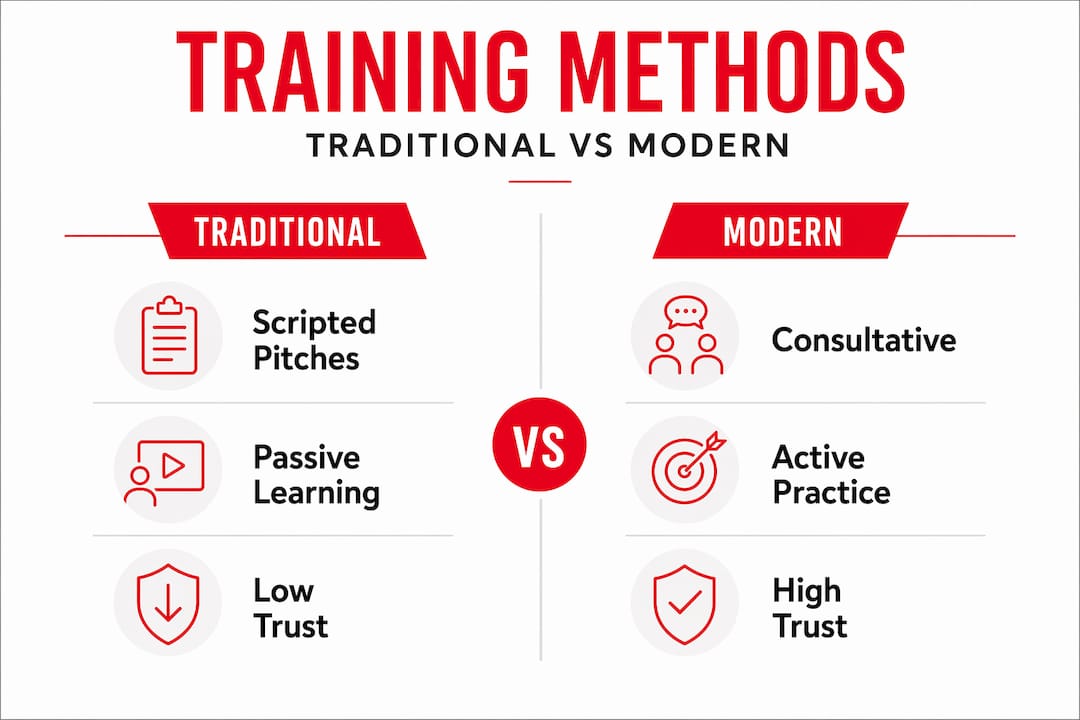
| Factor | Traditional training | Modern methodology |
|---|---|---|
| Core approach | Scripted pitches and closing techniques | Consultative, education-based conversations |
| Learning format | Passive lectures and reading materials | Active role-play and real-world simulations |
| Objection handling | Overcome and redirect to close | Acknowledge, Clarify, and Redirect as buying signals |
| Client relationship | Transactional, short-term focus | Trust-based, referral-generating relationships |
| Agent engagement | Low retention, high burnout | Higher confidence and faster skill development |
| Outcome data | Lower conversion, longer closure time | 31% better conversion rates, 18% shorter deal cycles |
The research on passive training is clear and unflattering. Lectures and static content account for roughly 10% of actual sales skill development. The other 90% comes from doing. Yet most onboarding programs at brokerages still rely heavily on orientation meetings, policy handbooks, and watching senior agents work. Without sales-readiness training built into early onboarding, new agents enter what trainers call a “dead zone.” They have a license and no practical tools.
Traditional pushy sales tactics create a second problem beyond poor conversion. They damage trust at the relationship level, which in real estate is career-ending. A client who felt pressured into a deal will not refer their neighbor. Every referral you do not receive because of a single high-pressure close represents years of compounding lost income.
Pro Tip: If your brokerage’s onboarding program does not include at least two structured role-play sessions in the first 30 days, build your own. Find a training partner, pick five common objection scenarios, and run them weekly. You will outpace colleagues who waited for formal training.
Knowing the methodology is one thing. Putting it into a repeatable practice routine is where most agents fall short. Here is how to build an implementation plan that actually sticks.
Pro Tip: For new agents without prior sales experience, the shift from thinking like a salesperson to thinking like a consultant is the single most important mindset change you can make in year one. Everything else follows from it.
The tools available to real estate agents today make consistent practice more accessible than ever. The challenge is choosing the right tools rather than accumulating platforms that go unused.
Compliance education is also becoming a technology-driven category. Digital tracking of continuing education hours, state-specific ethics modules, and automated renewal reminders remove the administrative friction that has historically caused good agents to fall out of compliance accidentally.
I have worked with hundreds of agents across different markets, and the pattern I keep seeing is consistent: the agents who resist role-play the hardest are almost always the ones who need it most. Not because they are bad at selling. Because they have developed deeply ingrained habits, usually from years of winging it, that feel natural but are quietly costing them deals.
The uncomfortable truth about real estate sales training is that methodology without mindset is just technique. I have watched agents learn the Acknowledge, Clarify, Redirect framework and then deploy it mechanically, which is somehow worse than not knowing it at all. Clients can tell the difference between an agent who genuinely wants to understand their concern and one who is running a script with better vocabulary.
What actually works is training that changes your orientation. When you stop thinking “how do I get this client to say yes” and start thinking “what does this client actually need to feel confident,” your entire approach recalibrates. Your questions get better. Your listening improves. Your close becomes a natural conclusion instead of a forced moment.
The agents I have seen build the most durable careers are the ones who treated their own skill development as seriously as their prospecting. They practiced weekly. They asked for feedback. They used technology to get reps in when no training partner was available. And they never confused knowing a methodology with having internalized it.
Embracing the tools that make practice more accessible, including AI simulations and on-demand coaching, is not about replacing human judgment. It is about getting enough repetitions that your judgment becomes instinctive under pressure.
— Noelle
The methodology you choose to train with shapes every client conversation you will have. Recareercenter offers flexible real estate education programs built around active learning, consultative selling skills, and real-world application rather than passive exam prep. Whether you are just starting out or looking to sharpen your technique after years in the field, the programs are designed to fit around your schedule. Explore how different learning formats compare and find the approach that fits how you learn best. For agents focused on long-term career growth, skill development beyond licensing is where the real separation happens.
Psychology-first consultative training combined with structured role-play consistently outperforms traditional script-based methods. Agents using this approach see 31% higher conversion rates and significantly shorter deal cycles.
Role-play builds the neural pathways that passive learning cannot, because it forces you to respond under simulated pressure. Research shows that 70% of sales skill development comes from real-world practice rather than lectures or reading.
Clients research agents before they meet them, and agents who can speak confidently about fiduciary duty and Fair Housing principles close trust gaps early. Deep knowledge of ethical standards functions as a genuine business differentiator, not just a compliance requirement.
Teach to Sell is a consultative framework where agents lead conversations with market education rather than persuasion, letting informed clients arrive at confident decisions on their own. This approach builds trust and generates more consistent referral-based income than pressure-oriented selling.
Experienced agents benefit most from training that skips foundational content and focuses on market-specific playbooks and advanced objection handling. Tailored programs can cut ramp-up time nearly in half compared to generic onboarding.